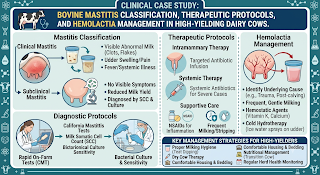
Parenchymal inflammation of the mammary gland, commonly known as Mastitis, is the biggest economical threat to any dairy operation. Mastitis is triggered by a wide range of environmental and contagious pathogens such as bacteria, viruses, fungal, and mycoplasma, which severely impair tissue structure, decrease milk production, and alter milk composition.
High-yielding Holstein-Friesians and Jerseys often have suppressed immune barriers due to systemic stress and high metabolic demands, rendering teat canals highly susceptible to opportunistic microbial invasion.
1. Clinical Classification & Etiology
Mastitis presents a broad range of clinical severity depending on the animal’s immune competence and pathogen virulence:
Peracute Mastitis: An explosive, hyper-acute presentation occurring within 24 to 48 hours. It causes profound destruction of udder quarters with toxic vascular collapse, severe pyrexia upto 105’F and complete cessation of milk secretion (replaced by serous foul-smelling fluid).
Acute Mastitis: Characterized by classic inflammation signs such as severe quarter edema (swelling), acute pain, localized heat and fever of the body. Milk has flakes or clots or watery consistency.
Chronic Mastitis: Long-standing persistent infection with progressive parenchymal fibrosis (induration/hardening of the udder quarter). It is characterized by low-grade pain, tissue swelling and periodic flare-ups.
Subclinical (subacute) Mastitis: The “silent killer” of dairy herds. It presents with no visible signs of inflammation such as swelling, localized heat and pain of the udder. The only clinical sign is a sudden drop in milk yield and a sharp rise in Somatic Cell Count (SCC).
2. Dr.’s Clinical Thought Process: Rational Therapeutics & Hemolactia
🩺 Clinical Rationale on Mastitis & Hemolactia Management:
“When managing acute mastitis, relying solely on systemic antibiotics is often ineffective. If blood is present in the milk (Hemolactia), it indicates acute capillary damage or erythrocyte fragility due to hypophosphatemia. In such cases, combining systemic hemostatic agents such as Ethamsylate or Vitamin K with parenteral Phosphorus (Tonophosphan) is used to stabilize microvascular permeability and restore red cell integrity. In addition, to prevent the recurrent flare-ups of chronic mastitis in high-producing cows, aggressive parenteral antioxidant therapy (Vitamin A, Vitamin E, Selenium) should be employed to counteract oxidative stress and boost neutrophil phagocytosis.”
3. Targeted Acute Treatment Protocol (400–500 kg / 900–1100 lb Cow)
A. Systemic Antibacterial Therapy
Ceftiofur Sodium / Hydrochloride:
Target Dose: 1.1 to 2.2 mg/kg or 0.5 to 1.0 mg/lb
Administration: Intramuscular (IM) or Subcutaneous (SQ) once daily (SID) for 3 to 5 consecutive days.
Indication: Preferred third-generation cephalosporin with zero milk withdrawal period in many jurisdictions.
Enrofloxacin (10% Solution):
Target Dose: 5.0 mg/kg or 2.3 mg/lb
Administration: Slow Intravenous (IV) or SQ for 3 days.
Gentamicin Sulfate:
Target Dose: 4.0 mg/kg or 1.8 mg/lb
Administration: Slow IV or IM (Note: Check meat withdrawal regulations before use).
B. Anti-Inflammatory & Analgesic Support (NSAIDs)
Meloxicam:
Target Dose: 0.5 mg/kg or 0.23 mg/lb
Administration: Intravenous (IV) or Subcutaneous (SQ) single dose or repeated every 24 hours.
Flunixin Meglumine:
Target Dose: 1.1 to 2.2 mg/kg or 0.5 to 1.0 mg/lb
Administration: Slow IV every 24 hours to neutralize circulating endotoxins in peracute cases.
Ketoprofen:
Target Dose: 3.0 mg/kg or 1.4 mg/lb
Administration: IV or IM daily for up to 3 days.
C. Hemolactia Management (Blood in Milk Protocol)
Ethamsylate (Hemostatic Support):
Target Dose: 10.0 to 15.0 mg/kg or 4.5 to 6.8 mg/lb
Administration: 15 to 20 mL deep IM or slow IV to stop capillary bleeding.
Vitamin K Injection:
Volume & Route: 10 mL IM daily for prothrombin synthesis.
Phosphorus Supplementation (Tonophosphan / Tonojil 20%):
Volume & Route: 15 to 20 mL slow IV or IM for correction of hypophosphatemic vascular fragility.
D. Immunomodulatory & Antioxidant Support
Vitamin A, Vitamin E, and Selenium Complex:
Target Dose: 50 IU/kg; Vitamin E + 0.05 mg/kg; Sodium Selenite IM.
Indication: Restores mammary epithelial cell barriers and boosts local immunity in high-producing cows under peak lactation stress.
4. Text-Based Dosage & Protocol Reference
1. Ceftiofur Sodium (Broad-Spectrum Beta-Lactam)
Target Pathogens: Gram-positive and Gram-negative mastitis pathogens
Dosage (mg/kg): 1.1 – 2.2 mg/kg
Dosage (mg/lb): 0.5 – 1.0 mg/lb
Route: Subcutaneous (SQ) or Intramuscular (IM)
Clinical Notes: Ideal choice for acute environmental mastitis without compromising milk discard economics where approved.
2. Meloxicam (Non-Steroidal Anti-Inflammatory)
Indication: Edema reduction, pain and fever
Dosage (mg/kg): 0.5 mg/kg
Dosage (mg/lb): 0.23 mg/lb
Route: Intravenous (IV) or Subcutaneous (SQ)
Clinical Notes: Long half-life provides sustained 24-hour anti-inflammatory effect with minimal gastrointestinal upset.
3. Ethamsylate (Capillary Stabilizing Agent)
Indication: Acute Hemolactia (blood in milk)
Calculated Volume: 15 – 20 mL total dose per adult bovine upto 450 kg
Route: Intramuscular (IM) or Slow Intravenous (IV)
Clinical Notes: Combine with parenteral Phosphorus (20 mL – IV) for rapid cessation of vascular bleeding within 12–24 hours.
5. Herd Biosecurity & Teat Canal Post-Milking Management
Pharmacological treatment must be augmented with biosecurity and milking parlor sanitation to prevent cross-contamination:
1. The 30-Minute Standing Post-Milking Protocol:
Immediately after machine or hand milking, the smooth muscle teat sphincter sphincter remains open for 30 to 45 minutes.
If a cow lies down on contaminated bedding during this time, then environmental pathogens can move up the streak canal.
Management Action: Give fresh, palatable feed and forage immediately at the feed bunk after milking to keep cows standing upright for at least 30-45 minutes until teat sphincters are completely closed.
2. Shed Sanitation & Barrier Protection:
Keep dry, clean, lime-washed bedding to decrease E. coli and environmental streptococcal loads.
Use post-milking teat dips containing iodophor or chlorhexidine barrier solutions to seal off teat ends after harvest.