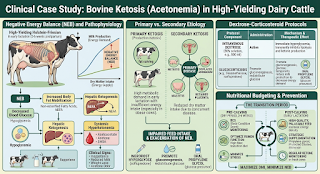
Bovine Ketosis (Acetonemia) is a significant metabolic disease, which commonly affects high-yielding dairy cows and buffaloes, particularly during the first months of lactation. Contrary to numerous infectious and contagious diseases, ketosis is non-infectious and non-contagious. It develops due to a severe negative energy balance (NEB) similar to Hypocalcemia (Milk fever) caused by calcium deficiency or Lactation Tetany – Mg deficiency. When animals’ energy expenditure (EE) for milk production exceeds their metabolizable energy (ME) intake, cows start mobilizing their body fat for energy production. In the liver, beta-oxidation of free fatty acids is impaired, and ketone bodies are produced as by-products.
1. Pathophysiology, Onset, and ClassificationThe disease emerges 2-8 weeks post-partum, often when animals reach their peak milk yield (e.g., 40 000 to 50 000 ml/day for Holstein-Friesian cows).A. Primary KetosisCause: Primary ketosis is caused by an insufficient supply of glucogenic nutrients in the diet.Mechanism: Body fat is mobilized to produce energy; animals lose weight, develop fatty liver syndrome, and increased concentrations of ketone bodies in blood, milk, and urine. Patients refuse to eat energy-rich concentrates and only eat coarse feeds.B. Secondary KetosisCause: Anorexia due to a concurrent disease in a high-yielding cow.Common causes of anorexia: Theileriosis, Babesiosis, Pyrexia, Acute ruminal acidosis, Metritis, Mastitis, or TRP.Therapeutic implication: The causative agent of secondary ketosis should be treated by specific anti-parasitic, anti-bacterial, or anti-inflammatory agents prior to ketosis treatment.Clinical manifestations:Loss of body condition and body weight due to fat breakdown.Reduced milk yield with a characteristic acetone smell of breath, milk, and urine.Selective eating of coarse feeds as compared to protein-rich concentrate.Nervous form of ketosis presents with pica, head pressing, aimless wandering, licking of walls, and staggering.
2. Dr.’s Reasoning on Energy Budget and Secondary Etiology Management🩺 “Ketosis is an accountant’s disease – when animals starve (either due to poor diet or concurrent illness), but keep producing milk. A cow producing 40 000-50 000 ml of milk per day has colossal energy requirements to sustain lactation. When a dairy farmer sees ketosis in one of his cows, the first task is to decide if it is primary (due to poor nutrition) or secondary (due to a concurrent illness). Both conditions require different treatments. If a cow develops Theileriosis – a tick-borne protozoan disease – and stops eating, her milk yield will still be high, but the energy expenditure on lactation will not decrease. In other words, the cow will develop secondary ketosis. To treat such cows, I would inject 25% dextrose solution to rapidly increase the blood glucose level and prescribe isoflupredone acetate to stimulate endogenous glucose production. A farmer who has managed to treat Theileriosis should start adding propylene glycol to the cow’s diet to inhibit fat breakdown in the future. To prevent ketosis, animals should get 1kg of energy-rich concentrate for each 2 liters of milk produced, plus 1.5 to 2kg for maintenance and another 1.5 to 2kg for cows in the dry period.”
3. Energy Budget Calculation for Ketosis PreventionTo prevent primary ketosis in high-yielding cows, the amount of concentrate (energy-rich feed) should be calculated as 1kg of concentrate per 2 liters of milk. For example, if a cow produces 50 liters of milk per day, her maintenance ration consists of 25 kg of concentrated feeds. Besides, a cow should get an additional 1.5 to 2 liters of concentrate per day to compensate for body weight loss. Finally, animals kept for breeding purposes need extra 1.5 to 2 liters of concentrate to prepare for the next calving during the dry period.
4. Symptomatic Therapy in Ketosis;
1. Hypertonic Dextrose (25-50%) Solution for HypoglycemiaTarget: Cessation of gluconeogenesis crisisThe recommended dose: 1000 to 2000 mlRoute and frequency: Slow intra venous (IV) infusionClinical pharmacology: Increases blood glucose levels, stimulates endogenous insulin production to suppress peripheral lipolysis.
2. Propylene Glycol or GlycerolTarget: Maintenance of gluconeogenesisThe recommended dose: 250-400 ml twice a day (BID) on the first day and 150-200 ml once a day (QD) for the next 3-5 days.Route and frequency: Oral drench (PO).Clinical pharmacology: Acts as a precursor for glucose; converted to propionate in the rumen.
3. Isoflupredone Acetate – GlucocorticoidTarget: Stimulation of gluconeogenesisThe recommended dose: 0.02-0.04 mg/kg or 0.009-0.018 mg/lb, or 10-20 mgRoute and frequency: One intra-muscular (IM) injection.Clinical pharmacology: Increases the production of glucose in the liver. Avoid in cows at risk of abortion (e.g., in late pregnancy).
4. Exogenous Regular InsulinTarget: Inhibition of lipolysis and promotion of glucose utilization.The recommended dose: 150-200IURoute and frequency: Subcutaneous (SC) or IM injection combined with dextrose infusion.Clinical pharmacology: Suppresses hormone-sensitive lipase, stops ketone body production.
5. Symptomatic therapy: Polyvitaminic B-complex with liver extract – 10-15 ml IM per day, Sodium acid phosphate or Phosphorus injection – 15-30ml IV/IM per day, Biotin and Cobalt – oral administration, to support the Krebs cycle and rumen function.
5. Preventive Recommendations
Group prevention: Ketosis is a non-contagious disease; thus, the occurrence of more than one sick animal on a farm suggests the presence of an internal management error rather than a contagious infection.
Counseling for owners: Transitions from dry to lactating period should be slow (during the last 3 weeks of pregnancy). The animal’s body weight should not exceed BCS>3.75/5 to avoid post-partum anorexia.