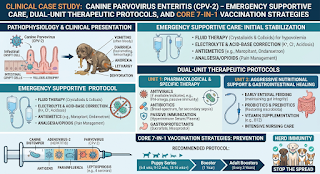
Canine Parvovirus Type 2 is one of the most fatal and contagious viral infections affecting puppies at the tender age of six months and unimmunized adult dogs world-wide. The virus has a peculiar proclivity for rapidly multiplying intestinal crypt epithelial cells and replicates aggressively within the lymphoid tissue, resulting in severe gastroenteritis, panleukopenia, and endotoxemia in the affected dogs. As a viral infection, direct antibiotic intervention to eliminate the causative organism (virus) is not recommended; instead, the treatment focuses on aggressive supplemental life-support measures, including fluid balancing, antiemetic intervention, secondary bacterial infection prevention, and core immunization.
1. General Symptomatology & Diagnostic Indications
The most vulnerable population to the infection is the puppies lesser than six months and unvaccinated adult dogs. The acute clinical signs of parvovirus infection include intractable vomiting, anorexia, hemorrhagic gastroenteritis, pyrexia, and severe lethargy. Additionally, there are signs of severe hypovolemic dehydration such as loss of skin elasticity, sunken eyes, prolonged capillary refill time (>2.5 seconds), and dry mucous membrane.
2. Dr.’s General Considerations: Parvo Support Care and Gastrointestinal Microbial Balance Restoration
🩺 “In parvovirus-induced enteritis, the primary mortality factors are not the virus per se but volume-deficit-induced shock, electrolyte imbalance, and bacterial translocation causing sepsis. Since the targeted anti-viral cure is unavailable, the fluid resuscitation using Ringer’s Lactate (RL), Dextrose Normal Saline (DNS), or 0.9% Normal Saline (NS) is of utmost importance. Combined antiemetic and gastroprotective medication like Ondansetron and Ranitidine/Pantoprazole respectively allows the gastric mucosa to heal. The use of broad-spectrum antibiotics such as Ceftriaxone or Metronidazole prevents bacterial infection from invading the bloodstream via the damaged intestinal mucosa. The oral rehydration salts (ORS) and natural probiotics (curd/yogurt cultures) help in restoring the vital gut microbiota when the dog is able to tolerate oral liquids.”
3. Parvo Emergency Treatment Protocol (10 kg / 22 lb Canine Baseline)
A. Fluid Resuscitation & Electrolyte Balance Maintenance
Ringer’s Lactate (RL) & Dextrose Normal Saline (DNS):
Dosage: 50 to 90 mL/kg/day or 23 to 41 mL/lb/day fluid volume calculated for a given percentage of fluid loss (8-10% fluid deficit)
Administration: Intravenous (IV) fluid drip to restore peripheral pulses and capillary refill time
0.9% Normal Saline (NS):
Indication: Selected for volume expansion and chloride replacement in hypochloremia and hyponatremia cases due to the severe vomiting associated with parvovirus infection.
B. Antiemetic & Gastroprotection Agents
Ondansetron (5-HT3 Antagonist):
Dosage: 0.1 to 0.2 mg/kg (0.045 to 0.09 mg/lb)
Administration: Slow Intravenous (IV) or Subcutaneous (SQ) every 8 to 12 hours
Clinical Notes: Effective in arresting severe emesis
Ranitidine / Pantoprazole (Acid Suppressant):
Dosage (Ranitidine): 0.5 to 2.0 mg/kg (0.23 to 0.9 mg/lb) IV or SQ every 12 hours
Clinical Notes: Attenuates hyperacidity and subsequent gastric ulceration
C. Secondary Bacterial Infection Prevention
Ceftriaxone Sodium (3rd Generation Ceph):
Dosage: 15.0 to 25.0 mg/kg (6.8 to 11.3 mg/lb)
Administration: Slow IV or IM every 12 hours
Clinical Notes: Prevents systemic Gram-negative septicemia
Metronidazole (Synthetic Antiprotozoal + Antibacterial Agent):
Dosage: 10.0 to 15.0 mg/kg (4.5 to 6.8 mg/lb)
Administration: Slow IV infusion over 20 minutes every 12 hours
Clinical Notes: Covers anaerobic enteric flora and reduces bloody diarrhea
D. Microbial Restoration & Oral Hydration
ORS (Oral Rehydration Salts):
Administration: Micro-enteral bolus (1 to 2 mL/kg every 2 hours) when active vomiting ceases to aid in enterocyte repair
Probiotic & Curd Support:
Clinical Indication: Administer small amounts of curd/yogurt or specialized probiotic cultures to help accelerate the recovery of the gut microflora in the dog recovering from parvovirus infection.
4. Drug Dosage & Protocols (In Text)
1. Ondansetron HCl (Central/Peripheral Antiemetic)
Target Indication: Intractable vomiting associated with parvovirus infection
Dosage (mg/kg): 0.1 – 0.2 mg/kg
Dosage (mg/lb): 0.045 – 0.09 mg/lb
Route: Slow Intravenous (IV) or Subcutaneous (SQ)
Clinical Notes: Administration before fluid or oral administration helps prevent aspiration pneumonia
2. Ceftriaxone Sodium (Broad-Spectrum Beta-Lactam)
Target Indication: Secondary bacterial translocation prevention
Dosage (mg/kg): 15.0 – 25.0 mg/kg
Dosage (mg/lb): 6.8 – 11.3 mg/lb
Route: Intravenous (IV) or Intramuscular (IM)
Clinical Notes: Crucial to restore impaired mucosal barrier defense mechanism during leukopenic phase
3. Metronidazole Infusion (Anaerobic & Antiprotozoal Coverage)
Target Indication: Hemorrhagic enteritis with anaerobic overgrowth
Dosage (mg/kg): 10.0 – 15.0 mg/kg
Dosage (mg/lb): 4.5 – 6.8 mg/lb
Route: Slow IV infusion (over 15–20 minutes)
Clinical Notes: Excessive dosage can cause temporary neurotoxicity; follow the weight-based limitations strictly
5. Prevention: Core 7-in-1 Combination & Rabies Vaccination
Proactive immunization is the only sure way to prevent Canine Parvovirus and other deadly diseases among the dogs.
Preventive Measures for Canine Parvovirus and Other Diseases
1. The 3-Month / 12-Week Primary Immunization Benchmark: The maternal antibody protection decreases significantly at the 12th week, necessitating the 7-in-1 Combination Vaccine to protect the puppy against the Canine Parvovirus, Canine Distemper Virus, Canine Adenovirus Type-1 & 2, Canine Parainfluenza, Leptospira species, and Anti-Rabies Vaccine (ARV).
2. Annual Booster Requirement: To ensure good circulating anti-body titers against virulent field strains like CPV-2a, CPV-2b, and CPV-2c, the 7-in-1 combination and Anti-Rabies Vaccine (ARV) require a yearly booster dose throughout the life of the canine.
Core Canine Vaccination Guidelines and Preventive Measures
Proactive immunization is the only way to ensure protection against Canine Parvovirus and other deadly infectious diseases. Here is a detailed vaccination schedule for canine core immunization:
6 to 8 Weeks (Puppy DP / Core Primary Dose): Primary immunizing dose against Parvovirus and Distemper Virus as the maternal antibodies begin to taper.
12 Weeks / 3 Months (7-in-1 Combination + ARV First Dose): This core immunizing dose is a protective measure against Parvovirus (CPV), Distemper Virus (CDV), Canine Adenovirus Type-1 and Type-2 (CAV), Canine Parainfluenza (CPI), Leptospira species, and Anti-Rabies Vaccine (ARV).
16 Weeks (7-in-1 Combination Booster): Essential booster dose to enable the puppy’s immune system to mount a sustained long-standing protection response
Annual Booster Schedule: Mandatory single-dose booster of 7-in-1 combination and Anti-Rabies Vaccine (ARV) each year to maintain the required circulating antibody titers throughout the life of the dog.