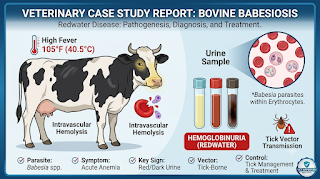
Bovine Babesiosis, otherwise referred to as Redwater disease, constitutes an intracellular protozoan parasitic infection primarily affecting cattle by way of haemolytic action of the parasite species Babesia bovis and Babesia bigemina.
Acute outbreaks of babesiosis among productive dairy cows, e.g., Holsteins and Jerseys, if untimely treated, often culminate in death due to respiratory insufficiency or circulatory collapse within 48 hours.
1. History & Diagnostics
Patient: Adult Holstein-Friesian / Jersey Dairy Cow
Estimated Weight: 400 kg (880 lbs)
Main Complaints: Sudden development of high fever (105^F/40.5^C), extreme depression, loss of appetite, labored breathing, and dark red-stained urine (hemoglobinuria).
Physical Exam Findings:
Pale to yellowish mucous membranes on vulvar and scleral inspection
Reduced rumen motility
Pounding heart rate with audible heart sounds from severe blood loss
2. Dr.’s Clinical Reasoning: Fluid & Hemolytic Assessment
🩺 Dr.’s rationale behind fluid management:
“In managing bovine babesiosis, the decision to provide IV fluid therapy is dictated by the extent of hemolysis and the packed cell volume (PCV). In chronic cases where anemia is severe (PCV < 12%) or in cases that have reached the terminal stage, aggressive fluid therapy is absolutely contraindicated; massive infusions of crystalloid fluids leads to severe hemodilution, which exacerbates tissue hypoxia and may cause acute pulmonary edema. On the other hand, in early stages of infection where hemoglobin levels are normal, a moderate dose of Normal Saline (1 Liter IV) is an effective vehicle for administering IV therapeutics without reducing the oxygen-carrying ability of the blood.”
3. Acute Treatment Regimen (400 kg Cow)
A. Antiprotozoal Treatment (Main Pathogen)
Diminazene Diaceturate:
Target Dose: 3.5 mg/kg (1.6 mg/lb)
Administration: 25ml deeply administered Intramuscularly (IM).
Mechanism: Rapid clearance of intracellular parasites. It is worth noting that a single dose of diminazene is often curative for babesiosis; do not repeat within 7 days to prevent CNS toxicity.
B. Secondary Antimicrobial Treatment
Oxytetracycline (50 mg/ml solution):
Target Dose: 7.5 to 10.0 mg/kg (3.4 to 4.5 mg/lb)
Total Volume: 60 to 80 ml administered Intravenously (IV) via slow fluid infusion line.
Mechanism: Broad-spectrum secondary antibacterial prophylaxis and inhibition of concurrent rickettsial pathogens (e.g., Anaplasma marginale).
C. Antipyretic & Metabolic Support
Analgin (Metamizole Sodium):
Volume & Route: 20 ml slow IV or IM.
Indication: Rapid antipyretic to bring the high temperature (105^F) down.
Phosphorus & Energy Supplementation (Tonophosphan / Tonojil 20%):
Volume & Route: 15 to 20 ml slow IV.
Indication: Correction of inorganic serum phosphorus levels to stabilize red blood cell membranes and prevent further post-hemolytic hemoglobinuria.
D. Hematinic & Erythropoietic Therapy (Anemia)
Iron Dextran + Copper & Cobalt Injectable Complex (e.g., Feritas):
Volume & Route: 10 ml Intramuscularly (IM).
Indication: Stimulate bone marrow erythropoiesis to supply lysed red blood cells during the 3-day convalescence period.
4. Text-based Dosage & Administration Reference
1. Diminazene Diaceturate (7% Solution)
Target Pathogen: B. bovis, B. bigemina
Dosage (mg/kg): 3.5 mg/kg
Dosage (mg/lb): 1.6 mg/lb
Calculated Volume (400 kg): 25ml deep Intramuscular (IM)
Notes: Single-dose therapeutic. Ensure the injection is deep into the IM tissues in heavy muscle mass (neck or gluteal area) to avoid necrosis of the local tissues.
2. Oxytetracycline (50 mg/ml)
Target Pathogen: Secondary bacterial infections, Anaplasma co-infections
Dosage (mg/kg): 7.5 – 10.0 mg/kg
Dosage (mg/lb): 3.4 – 4.5 mg/lb
Calculated Volume (400 kg): 60 – 80 ml Intravenous (IV)
Notes: Diluted in 1L Normal Saline Solution (0.9% NaCl) and slowly infused (20–30 minutes).
3. Iron Dextran + Trace Mineral Complex (Injectable Hematinic)
Indication: Post-hemolytic regenerative anemia
Dose: 10 ml total dose per adult bovine (400 kg)
Route: Intramuscular (IM)
Notes: Repeat on Day 3 if mucous membranes remain pale.
5. Prognosis, Recovery & Vector Biosecurity
Remission: Noteworthy clinical improvement is often seen within 6 to 8 hours of therapy, evidenced by a drop in body temperature and stabilized respirations.
Continued Treatment: Maintenance of antipyretic, hematinic, and supportive therapy is recommended for 3 consecutive days.
Tick Control: Given that babesia is transmitted by ticks, eliminate vector presence in the facility, including the paddocks and barn, with acaricide sprays (e.g., Amitraz or Permethrin). Simultaneously, administer systemic antiparasitics (e.g., Ivermectin) to all contact animals to prevent vector transmission.