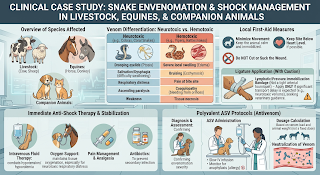
Snakebites are a crucial veterinary emergency for valuable animals (cattle, buffaloes, horses) and dogs due to their unmonitored grazing in pastures / farms. Thus, snakebites are detected late which leads to severe neurogenic shock, necrosis or coagulopathy.
The difference in venom pathophysiology is key to successful emergency triage. Many animals present with fatal neurogenic shock due to extreme panic even without poisonous bite.
1. Etiology: Venom classification and Pathophysiology
Snake venoms are complex mix of enzymatic proteins, neurotoxins, hemolysines and cardiotoxins broadly categorized into two main venomous profiles including non-poisonous snakebite:
A. Neurotoxic venoms (Elapid snakes: Cobra & Krait)
Pathophysiology: Presynaptic and postsynaptic neurotoxins block neuromuscular junction transmission.
Clinical effects: Rapid ascending flaccid paralysis, excessive salivation, dysphonia, ptosis, dysphagia, muscular weakness and respiratory failure due to diaphragm paralysis.
B. Hemotoxic venoms (Viper snakes: Russell’s viper & Saw-scaled viper)
Pathophysiology: Procoagulant enzymes deplete fibrinogen and vasculotoxins induce capillary endothelial rupture (disseminated intravascular coagulation).
Clinical effects: Profuse non-clotting bleed from bite site, gums, nose, local edema and necrosis, hematuria and dark venous blood alterations.
C. Non-poisonous snakebite / Psychogenic shock
Pathophysiology: Non-venomous bites (or dry bites of venomous snakes) induces huge endogenous catecholamine surge (epinephrine/norepinephrine) causing massive cardiovascular collapse.
Clinical importance: Animals succumb to either neurogenic or anaphylactoid shock from intense terror not related to envenomation.
2. Clinical presentation of Snakebite Emergencies
Sudden collapse accompanied by tremors, salivation or loud crying of a previously normal animal.
Local bite signs: Presence of twin fang punctures with rapid swelling + heat + oozing fluid from the site.
Shock signs: Pale / blue mucous membranes, weak thread-like pulse, decreased body temperature, dark or blackish venous blood upon venepuncture.
3. Dr.’s Clinical thinking: Snakebite management and shock countermeasures
🩺 Clinical considerations in managing Snakebite + Shock:
“In field practice, the fear of snakebite leads to animal death due to intense terror before venom toxicity manifests. During any acute collapse where snakebite is suspected, avoid trying to identify the species. Immediately give Polyvalent Anti-Snake Venom (ASV) if available, since it counteracts neuro- and hemotoxic manifestations. However, Anti-Snake Venom alone cannot reverse anaphylactic shock or massive histamine release. Combined high dose Corticosteroids (Dexamethasone/Hydrocortisone) + Parenteral antihistamines (Chlorpheniramine) help restore vascular tone and stop capillary leak. With non-poisonous bites, the animal is hyper-agitated and trembles due to fear. Use sedatives or tranquilizers to stabilize central nervous system drive to prevent fatal cardiac arrest. Counsel farm handlers on the use of ligatures to moderately slow venous return (not for hours) to avoid ischemic tissue gangrene during short distance transportation.”
4. Emergency drug regimen and Dosage guidelines
1. Polyvalent Anti-Snake venom (ASV)
Target: Neutralization of circulating neurotoxic and hemotoxic venom proteins
Dose: 50 to 100 mL (5 to 10 vials) IV slow reconstituted in Normal Saline (Large animals: Cattle, horses)
Dose: 10 to 20 mL (1 to 2 vials) IV slow (Dogs)
Route: Intravenous (IV) infusion
Notes: Polyvalent ASV is effective for Cobra, Krait, Russell’s viper and Saw-scaled viper venoms. Redose if systemic signs or non-clotting blood recurs after 2 to 4 hours.
1. Chlorpheniramine maleate (Parenteral Antihistamine / Avil)
Target: Counter systemic histamine surge, local swelling and anaphylactoid shock
Dose (mg/kg): 0.5 to 1.0 mg/kg
Dose (mg/lb): 0.22 to 0.45 mg/lb
Route: Intramuscular (IM) or slow IV
Notes: Block H1-receptors to prevent capillary permeability and airway constriction.
1. Dexamethasone Sodium phosphate / Hydrocortisone (Anti-shock Corticosteroids)
Target: Anaphylactic shock, cerebral edema and systemic inflammation
Dexamethasone: 0.1 to 0.2 mg/kg (0.045 to 0.09 mg/lb) IV/IM
Hydrocortisone: 2 to 4 mg/kg (0.91 to 1.82 mg/lb) IV slow
Notes: Re-establishes vascular stability andsuppresses venom complement cascade activation.
1. Tranexamic acid / Ethamsylate (Hemostatic Support)
Target: Active non-clotting bleed due to hemotoxic viper bite
Dose (mg/kg): 10 to 15 mg/kg
Dose (mg/lb): 4.5 to 6.8 mg/lb
Route: Slow IV or IM
Notes: Promote clot stabilizing and fibrinolysis inhibition during hemotoxic coagulopathy.
1. Tranquilizers & sedatives (Psychogenic / Agitation control)
Target: Severe fear-induced tachycardia, panic or hyper-excitability of non-poisonous bite
Xylazine HCL (Cattle): 0.05 to 0.1 mg/kg (0.022 to 0.045 mg/lb) IM
Acepromazine (Equine/Canine): 0.03 to 0.05 mg/kg (0.013 to 0.022 mg/lb) IM/IV
Notes: Calms central nervous system overactivity, decreases myocardial O2 demand and prevent cardiac failure during non-venomous bite shock.
1. Intravenous fluid resuscitation (Isotonic crystalloids)
Protocol: Administer Normal saline (0.9% NaCl) or Ringer’s lactate at 20 to 40 mL/kg/hr} during shock resuscitation and taper off to maintenance rate (50 to 60 mL/kg/day}). Re-establishes arterial circulation volume and renal perfusion.
5. Local first-aid and ligature guidelines
Wash bite site thoroughly with clean water and anti-septic or soap to remove surface venom residues. Avoid wide surgical incisions or suction which promotes deeper venom penetration.
Bite ligature guidelines:
Apply broad bandage or soft cord 5 to 10 cm proximal to the bite site on distal limbs.
Pressure constraint: The bandage should only occlude superficial venous return and lymphatic flow while leaving the artery pulse intact.
Gangrene warning: Complete blockage of arterial blood leads to total ischemia of the limb tissues resulting in necrosis and gangrene.
Ligature indication: Only use ligatures if veterinary clinical care is attainable within 10 to 15 minutes}. Loosen the ligature every 60 second for 10 to 15 min to maintain limb viability.