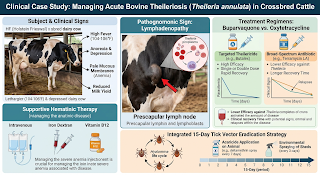
Bovine Theileriosis (Theileria annulata protozoal infection transmitted by Hyalomma ticks) is an acute, life-threatening lymphoproliferative and hemolytic condition affecting high yielding crossbred cattle (Holstein Friesian and Jersey Breeds).
In tropical and sub-tropical dairy setups, undetected tick infestation could lead to massive outbreaks of the condition. Theileria sporozoites invade host lymphocytes before attacking erythrocytes leading to rapid development of severe intravascular hemolysis within 48 to 72 hours overwhelming the pulmonary edema and hepatic hypoxia resulting in very high mortality if appropriate anti-protozoal intervention is not administered promptly.
1. Pathophysiology & Etiology
Vector Transmission: Inoculation of Theileria annulata sporozoites in to the host via the saliva of vector ticks (Hyalomma anatolicum).
Schizogony Phase: The sporozoites invade regional lymphocytes transforming in to macroschizonts (Kochs blue bodies). This causes significant lymphoblast proliferation and generalized lymphadenopathy.
Erythrocytic Piroplasm Phase: Release of merozoites from schizonts in to the Red Blood Cells (RBCs) transforming them in to piroplasms. This results in immune mediated extravascular and intravascular hemolysis with significant regenerative anemia and tissue hypoxia.
2. Clinical Presentation & Pathognomonic Indicators
Clinical diagnosis in the field is based on cardinal clinical signs:
Pathognomonic Prescapular Lymphadenopathy: Marked enlargement and tenderness of prescapular and precrural lymph nodes (salient diagnostic sign).
High-Grade Pyrexia: Acute spike in body temperature ranging from 105^F to 106^F (40.5^C to 41.1^C).
Ocular & Nasal Manifestations: Profuse bilateral lacrimation (watery eye discharge), photophobia, and petechial hemorrhages on the conjunctival mucosa.
Hemolytic & Anemic Collapse: Pale to icteric mucous membranes, tachycardia, dyspnea, muscle tremors, severe drop in milk yield and progressive emaciation.
3. Dr.’s Clinical Thought Process:Field Triage and Anemia Management
🩺 Clinical rationale on Bovine Theileriosis Management:
“When presenting with an acute case of Theileriosis in 500 kg Holstein Friesian or Jersey cow exhibiting 106^F fever, swollen prescapular lymph nodes and epiphora, immediate triage on the animal’s circulatory status is critical. In chronic cases (5 to 8 days duration) where hemolytic anemia has set in, aggressive intravenous fluid resuscitation must be strictly avoided due to risk of fatal pulmonary edema and cardiovascular overload. Buparvaquone (2.5 mg/kg) is the definitive drug and must be given as a single injection of 20 mL total dose for a 500 kg adult cow, it should not be repeated unnecessarily. In early stage non-anemic cases, high dose Oxytetracycline IV in Normal Saline provides excellent synergistic schizonticidal control. Finally, anti-protozoal therapy alone is insufficient and aggressive hematinic support containing Iron, Copper, Cobalt and B-complex vitamins (B1, B6, B12) is vital to stimulate erythropoiesis and restore functional hemoglobin levels.”
4. Comprehensive Therapeutic Regimen & Dosage Protocols
1. Buparvaquone (Definitive Specific Anti-protozoal)
Target Indication: Specific schizonticidal and piroplasmicidal action against Theileria annulata
Dosage (mg/kg): 2.5 mg/kg
Dosage (Total Dose for 500 kg Cow): 20 mL
Route: Deep Intramuscular (IM) in the neck muscle
Clinical Notes: Single-dose therapy. Do not repeat the dose within 48 to 72 hours unless indicated. Divide doses above 10mL in two separate injection sites.
1. Oxytetracycline Hydrochloride (Synergistic Anti-protozoal / Anti-bacterial)
Target Indication: Early stage Theileria schizont suppression and control of secondary bacterial infections
Dosage (mg/kg): 10 to 20 mg/kg
Total Dose: 80 to 100mL reconstituted in 1 Liter Normal Saline (0.9% NaCl)
Route: Slow Intravenous (IV) infusion
Clinical Caution: Avoid high IV fluid volumes in patients presenting with severe anemic collapse.
1. Anti-Pyretic & Non-Steroidal Anti-inflammatory (NSAID) Therapy
Analgin / Meloxicam:
Meloxicam Dosage: 0.5 mg/kg (0.23 mg/lb) IV/IM slow
Analgin Dosage: 10 to 20 mg/kg IV/IM
Target Indication: Rapid control of extreme hyperthermia (105-106^F) and systemic inflammatory pain.
1. Parenteral Vitamin B-Complex & Liver Tonics
Vitamin B1, B6, B12 (Thiamine, Pyridoxine, Cyanocobalamin): 10 to 15 mL IM/IV QD for 3 to 5 days.
Target Indication: Hepatic metabolic support, appetite stimulation and neuro-vascular recovery.
1. Hematinic & Mineral Support Protocol
Iron, Copper, Cobalt & Folic Acid Parenteral/Oral Preparations:
Iron Dextran: 5 to 10 mL deep IM every alternate day (2 doses).
Oral Hematinic Tonics: 50 to 100 mL PO daily for 15 days.
Target Indication: Accelerating bone marrow erythropoiesis to restore packed cell volume (PCV) and hemoglobin concentration following intravascular hemolysis.
5. Integrated Farm Vector Control & Biosecurity Protocols
Curing an individual animal is useless if the farm environment is infested with vector ticks. A comprehensive biosecurity strategy must be enforced:
A. Animal De-parasitization (Internal & External)
Endectocide Bolus Combination: Oral combination of Ivermectin + Fenbendazole administration to eliminate both gastrointestinal nematodes and circulating ectoparasites.
B. Shed Chemical Disinfection & The 15-Day Repeat Cycle Rule
1. Evacuation: Vacate all animals from the housing shed for a minimum of 24 hours.
2. Acaricidal Spraying: Thorough spraying of floors, wall cracks, feeding mangers and shed perimeters using Deltamethrin (1.25% EC) or Cypermethrin diluted as per manufacturer recommendations (2 to 3 mL/Liter of water).
3. The 15-Day Biological Rule: Tick eggs hidden in wall crevices are resistant to acaricidal sprays and hatch within 14 to 15 days. Disinfection must be strictly repeated every 15 days for 3 to 4 consecutive cycles to kill newly emerged tick larvae before they attain reproductive maturity.
C. Active Herd Monitoring
Thermal Screening: Routine daily body temperature checks across at risk crossbred stock.
Palpation Routines: Checking of prescapular lymph nodes during daily milking routines to detect early infection before development of clinical anemia.