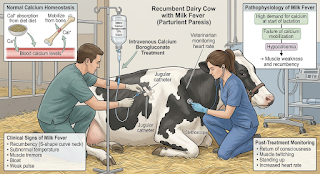
Milk Fever (Parturient Paresis) is an acute to subacute metabolic emergency in high-yielding dairy cattle characterized by severe hypocalcemia, generalized muscle weakness, loss of consciousness, and sternal to lateral recumbency.
While acute hypocalcemia occurring within 72 hours post-calving during heavy colostrum synthesis is strictly termed Milk Fever, serum calcium depletions occurring during mid-gestation or late lactation are classified as Subclinical or Chronic Hypocalcemia.
As calcium is indispensable for smooth and skeletal muscle contraction, neuromuscular transmission, and cardiac contractility, failure to rapidly restore ionized calcium levels leads to gastrointestinal stasis, downer cow syndrome, cardiac arrest, and death.
1. Pathophysiology: The Colostrum Calcium Drain
Colostrum Secretory Drain: Colostrum contains 2.3 gr calcium per liter i.e., more than double the concentration of normal milk. A cow producing 10 Liters of colostrum will mobilize over 23 grams of calcium into the udder within hours.
Extracellular Calcium Depletion: The normal extracellular calcium pool in an adult dairy cow is only about 8 to 10 grams. Sudden colostral drainage outpaces the homeostatic parathyroid hormone (PTH) response mechanisms, driving total serum calcium levels from normal (8.5 to 10 mg/dL) down to critical levels (< 5 mg/dL)
Neuromuscular Paresis: Lack of calcium at the neuromuscular junction blocks acetylcholine release, resulting in flaccid paralysis of skeletal muscles, intestinal smooth muscle atony, and vascular collapse.
2. Clinical Presentation & Diagnostic Indicators
Diagnosis in field practice is established through cardinal physical and rectal findings:
Stage 1 (Prodromal): Hypersensitivity, muscle tremors over the flank, head shaking, and mild ataxia without recumbency.
Stage 2 (Sternal Recumbency – Pathognomonic Posture): The cow sits in a sternal recumbency with a characteristic lateral kink in the neck (S-shaped curve).
Dry Muzzle & Hypothermia: The cow has a dry muzzle with loss of the normal beaded perspiration on the nasolabial mirror and subnormal rectal temperature (from normal 101.5^F down to 96.0’F).
Gastrointestinal Atony & Rectal Findings: Per-rectal examination reveals severe ruminal stasis and a full rectum packed with dry, firm, dark, mucus-coated feces due to calcium-deficient smooth muscle paralysis of the intestinal tract.
Stage 3 (Lateral Recumbency): Complete flaccidity, comatose state, weak pulse, severe bloat, and impending circulatory collapse.
3. Dr.’s Clinical Thought Process: Intra-Treatment Safety & Preventive Endocrine Priming
🩺 Clinical Rationale on Hypocalcemia & Milk Fever Management:
“When managing a post-parturient cow in sternal recumbency with a dry muzzle and subnormal temperature (98^F), immediate parenteral calcium replacement is mandatory. However, Calcium Borogluconate 25% (450 mL) must always be infused slowly via intravenous route under strict cardiac auscultation. Fast IV infusion triggers acute hypercalcemia, leading to cardiac arrhythmias and sudden cardiac collapse. Parenteral Calcium must be backed by Intravenous Phosphorus (20 mL) and Vitamin D3 injections, while advising morning sunlight exposure for 2 to 3 days to stimulate endogenous cutaneous Vitamin D synthesis and intestinal absorption. Crucially, preventing Milk Fever requires controlling pre-calving nutrition: never administer high oral calcium supplements during the last 30 days of gestation (dry period). High pre-calving calcium suppresses Parathyroid Hormone (PTH) and primes Calcitonin, leaving the cow unable to mobilize bone calcium post-calving. Replacing pre-calving calcium with Dietary Anionic Salts (DCAD) induces mild metabolic acidosis, priming PTH receptors for rapid post-calving calcium mobilization.”
4. Comprehensive Therapeutic Regimen & Dosage Protocols
1. Calcium Borogluconate 25% (Definitive Parenteral Replacement)
Target Indication: Immediate restoration of extracellular ionized calcium concentration
Total Dose: 450 mL
Route: Slow Intravenous (IV) infusion (first 300 to 350 mL IV slow, remaining 100 to 150 mL Subcutaneously)
Crucial Administration Protocol: Administer over a minimum duration of 15 to 20 minutes. Continuously monitor cardiac rate and rhythm via stethoscope over the left chest wall. If bradycardia, cardiac dysrhythmia, or sudden heart block occurs, immediately stop the infusion.
1. Sodium Acid Phosphate / Parenteral Phosphorus (Synergistic Mineral Support)
Target Indication: Rectifying secondary hypophosphatemia and supporting cellular ATP production
Dosage: 20 mL
Route: Intravenous (IV) slow or Deep Intramuscular (IM)
Clinical Notes: Calcium and Phosphorus operate in a strict metabolic ratio; co-administration prevents persistent post-treatment recumbency (“creeper cow syndrome”).
1. Vitamin D3 / Cholecalciferol (Intestinal Absorption Enhancer)
Target Indication: Stimulating synthesis of Calbindin (calcium-binding protein) in intestinal enterocytes
Dosage: 10 to 15 mL (5,000,000 to 10,000,000 IU)
Route: Deep Intramuscular (IM)
Supportive Care: Direct daily exposure to soft early-morning sunlight for 30 to 45 minutes to encourage cutaneous conversion of 7-dehydrocholesterol into active Vitamin D3.
1. Glucocorticoid Therapy (Prednisolone Sodium Phosphate)
Target Indication: Gluconeogenesis stimulation, anti-inflammatory stress management, and metabolic stabilization
Dosage (mg/kg): 0.1 to 0.2 mg/kg
Total Dose: 10 to 20 mL
Route: Intramuscular (IM) or Intravenous (IV)
1. Oral Calcium Gel Maintenance (Post-Standing Phase)
Target Indication: Sustained intestinal calcium release once the swallowing reflex fully returns
Dosage: 1 tube (300 to 400 grams Calcium Gel) orally after the cow regains standing posture, repeated 12 hours later.
Caution: Never drench oral fluids or gels while the cow is recumbent or lacks a swallowing reflex to prevent fatal aspiration pneumonia.
5. Preventive Pre-Calving DCAD (Dietary Cation-Anion Difference) Strategy
To completely eliminate Milk Fever outbreaks in high-yielding dairy farms, dietary management during the close-up dry period (last 30 days of gestation) must follow these physiological rules:
1. Withdraw High Calcium Inputs: Stop all oral calcium supplements, high-calcium mineral mixtures, and leguminous green fodders (like Lucerne/Berseem) during the final 30 days of gestation.
2. Implement Anionic Salts: Feed anionic salts (Ammonium Chloride, Magnesium Sulfate, Calcium Sulfate) to reduce the DCAD equation.
3. Mode of Action: Anionic diets induce a transient, mild systemic metabolic acidosis. This acidic pH sensitizes tissue receptors to Parathyroid Hormone (PTH), enabling immediate osteoclastic bone resorption and active intestinal absorption as soon as colostrogenesis begins post-parturition.