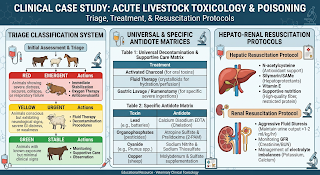
Acute toxicity in ruminants (cattle, buffaloes, sheep, and goats) presents a high mortality veterinary emergency. Poisoning broadly falls into 2 clinical categories namely- Anti-Nutritional Plant Toxins (e.g. HCN/Cyanide in immature sorghum, Nitrates/Nitrites, Saponins), and Chemical/Heavy Metal Ingestion (Organophosphates, Organochlorines, Carbamates, Arsenic, Lead).
Since ruminant gastrointestinal anatomy lacks an emetic reflex (preventing vomiting), ingested toxins are retained in the rumen undergoing continuous absorption into systemic circulation.
1. Pathophysiology & Clinical Presentation
Toxins disrupt central nervous system transmission, cellular respiration, and capillary endothelial integrity, presenting with distinct clinical features:
Pathognomonic Clinical Symptoms:
Hypothermia / Subnormal Body Temperature: Unlike infectious fevers (101^F / 38.3^C normal), acute toxic shock causes a severe drop in core body temperature to subnormal levels (94^F to 96^F / 34.4^C to 35.5^C).
Profuse Hypersalivation & Ataxia: Continuous foaming/drooling from the mouth accompanied by incoordination, staggering gait, muscle fasciculations, and recumbency.
Venous Blood Alterations: Venipuncture reveals coffee-brown or dark-black blood due to acute methemoglobinemia (in nitrate/nitrite toxicity) or severe tissue hypoxia.
Profuse Toxic Diarrhea: Rapid enterotoxin-induced intestinal hypermotility causing watery, foul-smelling diarrhea.
2. Dr.’s Clinical Thought Process: Diagnostic Triage & Decontamination Principles
🩺 Clinical Rationale on Emergency Toxicology Management:
“In livestock poisoning, rapid triage dictates survival. First, assess pregnancy and lactation status before administering anti-shock therapy: Dexamethasone is an irreplaceable life-saving corticosteroid in non-pregnant, non-lactating animals but it is strictly contraindicated in pregnant dams due to immediate abortion risks. Second, enforce a strict 24-hour oral water restriction; giving oral water solubilizes ruminal chemical toxins and accelerates systemic vascular absorption. Instead, rely on massive IV Normal Saline (2 to 4 Liters) to induce forced renal diuresis. Third, always request the chemical bottle, pesticide label, or plant specimen from the farmer-identifying the specific agent (OP, Carbamate, Cyanide or Snake species) allows for the precise, immediate deployment of targeted antidotes rather than relying solely on empirical care.”
3. Targeted Antidote Reference Protocols
When the causative agent is identified via sample inspection, specific antidote protocols must be executed immediately alongside Atropine Sulfate:
Organophosphates & Carbamates: The primary treatment combines Atropine Sulfate with Pralidoxime (2-PAM). Administer Atropine Sulfate at 0.2 to 0.5 mg/kg (a total dose of 15 to 20 mL, giving 1/3 IV and 2/3 IM/SC) to block muscarinic acetylcholine receptors. Follow with Pralidoxime (2-PAM) at 10 to 20 mg/kg slow IV to reactivate acetylcholinesterase enzymes.
Cyanide / Immature Sorghum (HCN): Administer Sodium Nitrite at 1 to 2g IV alongside Sodium Thiosulfate at 30 to 40g as a 20% solution IV. This dual-antidote combination converts cyanide-bound hemoglobin into non-toxic thiocyanate for safe renal excretion.
Nitrates, Nitrites & Fluorides: Administer Methylene Blue at 1 to 2mg/kg as a 1% solution diluted in normal saline via slow IV. This rapidly converts dark methemoglobin back into functional, oxygen-carrying hemoglobin.
Lead & Heavy Metals: Execute heavy metal chelation therapy using Calcium EDTA at 25 to 50 mg/kg IV, divided into two daily doses for 3 to 5 consecutive days. This chelates circulating heavy metal ions into stable, excretable complexes.
4. Comprehensive Therapeutic Regimen & Support
1. Normal Saline 0.9% NaCl (Intravenous Diuresis)Target Indication: Vascular expansion, toxin dilution in blood, and forced renal clearance
Dosage (Large Ruminants): 2 to 4 litres IV rapidlyRoute: Intravenous (IV)
Clinical Notes: Replaces oral fluids during the 24-hour oral water restriction period, preventing cardiovascular collapse.
1. Dexamethasone Sodium Phosphate (Anti-Shock Corticosteroid)Target Indication: Endotoxic shock, severe hypotension, and vascular collapseDosage (mg/kg): 0.1 to 0.2 mg/kgDosage (mg/lb): 0.045to 0.09 mg/lbRoute: Intravenous (IV) or Intramuscular (IM)
Contraindication Warning: DO NOT USE in pregnant animals (induces abortion) or lactating cows where milk preservation is critical without owner consent.
1. Saline Purgatives (Magnesium Sulfate / Sodium Sulfate)
Target Indication: Gastrointestinal evacuation of unabsorbed ingested toxinsDosage: 250 to 500 g PO dissolved in a minimal volume of warm water
Clinical Notes: Promotes osmotic catharsis to purge toxic ruminal digesta without causing secondary fluid shifts.
1. Hepatoprotective & Renal Support ProtocolLiver Extracts & Silymarin / Liv-52 Solution: 20 to 30 mL IM/PO daily for 5 days. Essential for supporting hepatic parenchymal cells during heavy first-pass toxic metabolism.
Vitamin B-Complex with Choline & Inositol: 10 to 15 mL IM daily to assist hepatic microsomal enzyme recovery and peripheral nerve repair.
5. Field Sample Handling & Preventive Guidelines
Sample Submission Protocol: Always collect and inspect feed samples, suspected chemical containers, pesticide bags, or plant roots. In snakebite cases, identifying snake morphology (e.g. Cobra vs. Viper) ensures correct Polyvalent Anti-Snake Venom (ASV) selection.
Rumen Evacuation: In severe cases of massive toxic feed ingestion where antidotes fail to control absorption, emergency rumenotomy or large-bore stomach tube lavage should be considered to physically clear the ruminal vault.