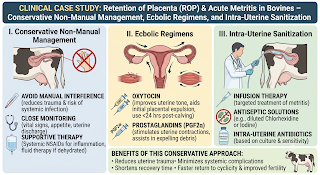
Retention of placenta (ROP) in dairy cattle and buffaloes is the inability to expel fetal membranes within 8 to 12 hours post-calving. Physiologically, placental separation involves the complex enzymatic breakdown and detachment of approximately 100 maternal caruncles from fetal cotyledons (placentomes).
When the placentome separation fails, forced manual removal often leads to severe endometrial damage, cotyledonary tearing, profuse uterine hemorrhage, and incomplete membrane clearance. This non-sterile trauma fosters bacterial proliferation, which, in turn, incites severe acute metritis, pyometra, secondary mastitis, and a permanent drop in the total lactational milk yield.
1. Clinical Presentation & Hazards of Manual Traction
Pathophysiological Risk Indicators:
Failure of Physiological Detachment: The placentomes remain locked due to uterine atony, hypocalcemia, or premature caruncle-cotyledonary edema.
Toxemia & Systemic Metritis: The retained necrotic tissues undergo putrefaction within 24 to 48 hours, releasing bacterial endotoxins into the systemic circulation.
The Metritis-Mastitis Complex: The systemically inflammatory response and endotoxemia secondary to metritis severely suppress systemic immunity, often inciting acute secondary mastitis and irreversible loss of the peak lactation yield.
Pitfalls of Violent Manual Removal:
Mucosal Hemorrhage & Laceration: Manual detachment tears caruncles, resulting in acute intra-uterine bleeding.
Incomplete Evacuation: Fragmented placental pieces remain trapped inside the uterine horns, transforming clean lochia into foul, purulent discharge (pyometra).
Delayed Uterine Involution: Mechanical irritation causes severe endometrial swelling, delaying normal uterine recovery for future estrus cycles.
2. Dr.’s Clinical Thought Process: Non-Invasive Management & Uterine Sanitization
🩺 Clinical Rationale on ROP & Metritis Management:
“Forced manual removal of the retained placenta does more harm than it does good in large animal practice. Pulling untransformed cotyledons causes severe tissue hemorrhage, and creates deep endometrial wounds. Instead, a conservative and non-invasive approach brings forth vastly superior clinical outcomes. Attaching a light weight to the visible membrane portion creates a mild constant traction without tearing the tissue, minimizing the stress and allowing the neonate to suckle to trigger an endogenous oxytocin surge, which naturally enhances uterine myometrial contractions. To manage residual bacterial decay, intra-uterine proteolytic boluses (Urea) and oral ecbolics should be used to purge necrotic debris naturally. Crucially, once the active foul discharge subsides, a 3-consecutive-day Intra-Uterine (IU) antibiotic infusion is essential to completely sanitize the endometrial lining, thereby preventing metritis-induced mastitis and preserving future reproductive conception rates.”
3. Conservative Field Management & Medical Protocols
A. Non-Invasive Mechanical & Endogenous Hormonal Support
1. Light Weight Application: Attach a small, clean weight to the external hanging portion of the placenta to apply gentle and constant downward gravitational pull.
2. Stress Reduction: Keep the dam isolated in a calm environment. Avoid standing directly in front of or alarming the animal, as the stress-induced adrenaline hinders the physiological uterine straining.
3. Suckling Reflex (Endogenous Oxytocin Release): Allow the newborn calf/buffalo calf to suckle teats often. Teat stimulation elicits a massive endogenous release of pituitary oxytocin, promoting natural rhythmic uterine contractions.
B. Intra-Uterine Proteolytic & Antiseptic Boluses
Proteolytic & Antibiotic Boluses: Place 2 to 4 Urea or Nitrofurazone/Furaltadone boluses deep into the uterine cavity/horns to accelerate the autolytic detachment of remaining placental tags and inhibit anaerobic bacterial decomposition.
C. Oral Ecbolics & Uterine Tonics
Herbal Ecbolic Regimens: Administer potent uterine tonics containing hot-nature carminative and oxytocic herbs (100 to 200 mL} PO BID for 3 to 5 days) to stimulate natural lochial evacuation without mechanical trauma.
D. Post-Evacuation Intra-Uterine (IU) Sanitization Protocol
3-Day IU Antibiotic Therapy: Once the main bulk of the placental tissue has detached, and active foul discharge begins to regress, perform intra-uterine infusions for 3 consecutive days to sterilize the endometrial lining and eliminate persistent bacterial metritis.
4. Text-Based Dosage & Protocol Reference
1. Cephapirin Sodium / Levofloxacin & Ornidazole (Intra-Uterine Formulation)
Target Indication: Endometrial sanitization & post-ROP acute metritis
Dosage: 30 to 60mL intra-uterine infusion once daily for 3 consecutive days
Route: Intra-Uterine (IU) via sterile catheter
Clinical Notes: Must be administered after the active necrotic discharge subsides to ensure direct drug contact with the endometrial mucosa.
2. Ceftiofur Sodium (Broad-Spectrum Systemic Beta-Lactam)
Target Indication: Febrile acute metritis & prevention of systemic endotoxemia
Dosage (mg/kg): 1.1 to 2.2 mg/kg
Dosage (mg/lb): 0.5 to 1.0 mg/lb
Route: Intramuscular (IM) or Subcutaneous (SC) once daily for 3 to 5 days
Clinical Notes: Zero milk withdrawal antibiotic choice for lactating dairy cows showing systemically fever (>103.5^F).
3. Meloxicam (NSAID / Anti-Inflammatory & Analgesic)
Target Indication: Uterine visceral pain & tissue swelling
Dosage (mg/kg): 0.5 mg/kg
Dosage (mg/lb): 0.23 mg/lb
Route: Intramuscular (IM) or Subcutaneous (SC)
Clinical Notes: Controls visceral pain, improves feed intake, and mitigates the inflammatory cascade affecting milk production.
5. Long-Term Reproductive & Lactational Prevention Guidelines
Milk Yield Preservation: Avoiding forced manual removal prevents systemic shock and severe milk drops, safeguarding the cow’s economic viability for the current lactation cycle.
Prevention of Metritis-Mastitis Complex: Prompt intra-uterine sanitization halts toxic bacterial translocation, significantly lowering secondary mastitis incidence.
Fertility Restoration: Completing the 3-day post-ROP intra-uterine antibiotic regimen ensures complete uterine involution, enabling the animal to return to normal fertile estrus within 45 to 60 days post-partum.