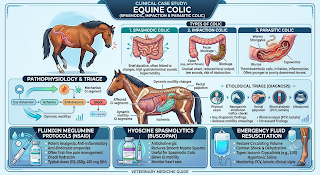
Equine colic is not a single entity of disease but a syndrome of abdominal pain that originates from the gastrointestinal tract, urinary system, or peritoneum. Equines have a hindgut fermentation system that is both complex, mobile, and delicate. Narrow anatomical junctures such as the pelvic flexure, and ileocecal junction make equines highly susceptible to acute gut stasis, gas distension, volvulus, and impaction.
Since equines have a low threshold for visceral pain, colic is one of the most frequent and high-mortality veterinary emergency management cases. Rapid etiological triage and immediate analgesia are critical to prevent fatal intestinal strangulation or irreversible endotoxic shock.
1. Pathophysiology & Etiological Classification
Colic syndromes can be classified into several distinct pathological mechanisms each with a different underlying cause:
Spasmodic & Tympanitic Colic: Violent, uncoordinated intestinal smooth muscle contraction or rapid gas accumulation triggered by sudden feed changes, cold water ingestion, or hyper-excitement.
Impaction Colic: Accumulation of dry, fibrous feed, sand, or foreign material in the pelvic flexure or cecum, secondary to dehydration, poor dentition, or lack of exercise.
Dietary Indiscretion & Carbohydrate Overload: Sudden introduction of concentrated grains, spoiled fodder, or abrupt pasture shifts.
Parasitic Colic: Thromboembolic colic due to Strongylus vulgaris larval migration within the anterior mesenteric artery, causing localized intestinal ischemia and necrosis.
Iatrogenic, Stress & Non-GI Causes: Drug-induced enteropathy, relocation stress, change of ownership, or acute urinary tract obstruction (urolithiasis or severe urinary retention).
2. Clinical Presentation & Behavioral Indicators
The severity of the clinical signs is directly correlated with the intensity of visceral pain:
Restlessness & Postural Dynamics: Constant standing up and lying down, pacing, pawing the ground, and standing with an extended posture (to relieve abdominal or urinary pressure).
Violent Rolling & Flank Watching: Rolling on the ground, kicking violently at the abdominal with hindlegs and repeatedly turning the head to look at the flank area.
Hyperhidrosis (Patchy to Profuse Sweating): Swelling profusely over the neck, shoulders and flank region due to extreme pain.
Auscultation Findings: Decreased or absent borborygmi (gut sounds) in impaction or hypermotile, high-pitched gas rushes in spasmodic colic.
Cardiovascular Compromise: Tachycardia (heart rate > 60 to 80 beats/min), prolonged Capillary Refill Time (CRT >3 seconds), and purple/toxic mucous membrane rings.
3. Dr.’s Clinical Thought Process: History Taking & Triage Protocol
🩺 Clinical Rationale on Equine Colic Management:
“In equine colic, never administer powerful analgesics before having done a thorough history taking. Always ask whether there has been a recent change in feed quality, a sudden shift in ownership or location, a change in workload or recent administration of new therapeutic drugs. Differentiate if the problem is due to dietary indiscretion, lack of water, or heavy parasitism. Visceral pain in horses escalates rapidly to self-inflicting trauma through violent rolling so immediate control of pain using Flunixin Meglumine combined with smooth muscle spasmolytics like Hyoscine Butylbromide is the preferred line of stabilization. Furthermore, aggressive IV fluid therapy using Normal Saline (0.9% NaCl) helps preserve intravascular volume that maintains renal clearance and prevents circulatory collapse.”
4. Comprehensive Therapeutic Regimen & Drug Protocols
1. Flunixin Meglumine (Gold Standard Visceral NSAID)
Purpose: Visceral analgesia, anti-inflammatory action, and to inhibit endotoxemia
Dose (mg/kg): 1.1 mg/kg
Dose (mg/lb): 0.5 mg/lb
Route: Intravenous (IV) slow
Notes: Flunixin Meglumine is the definitive visceral analgesic in equines. Avoid intramuscular administration it leads to clostridial myonecrosis.
2. Hyoscine Butylbromide / Buscopan (Antispasmodic & Visceral Muscle Relaxant)
Purpose: Relief of intestinal smooth muscle spasms and hypermotility
Dose (mg/kg): 0.3 mg/kg
Dose (mg/lb): 0.14 mg/lb
Route: Slow Intravenous (IV)
Notes: Rapidly relaxes GI smooth muscle sphincters. Transiently elevates heart rate so it is important to monitor cardiovascular parameters before injection.
3. Intravenous Fluid Resuscitation (Isotonic Normal Saline 0.9% NaCl)
Purpose: Intravascular volume expansion, rehydration, and to prevent endotoxic shock
Dose: 10 to 20 mL/kg/hr IV rapid resuscitation followed by maintenance infusion
Total Volume: 10 to 20 Liters for an adult 450 kg horse depending on hydration status
Notes: Re-establishes peripheral tissue perfusion and promotes renal function during severe abdominal pain and dehydration.
4. Parasitic Control & Anthelmintic Protocol
Purpose: Parasitic verminous arteritis and intestinal tapeworm / strongyle
Active Drug: Ivermectin (0.2 mg/kg PO) or Moxidectin + Praziquantel combination paste
Notes: Execute structured deworming schedules every 2-3 months. In acute colic, resolve pain and impaction before administering oral anthelmintics.
5. Nasogastric Decompression & Laxative Therapy (Impaction Cases)
Liquid Paraffin (Mineral Oil): 2 to 4 Liters via Nasogastric (NG) tube to lubricate dry intestinal impactions.
Epsom Salt (Magnesium Sulfate): 0.5 to 1.0 g/kg dissolved in warm water via NG tube to draw fluid into the intestinal lumen via osmotic action.