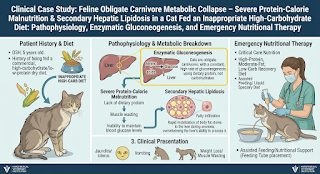
Cats (Felis catus) are strict, evolutionary obligate carnivores. Unlike omnivores (canines and humans) or herbivores (bovines and equines), cats’ metabolic, dental, and gastrointestinal systems are all specifically hardwired to process only meat.
Force-feeding your cat an inappropriate high-carbohydrate or non-animal protein diet will force their bodies to do what it was designed to—break down a cat’s own structural muscle mass to survive.
1. Comparative Anatomical & Physiological Markers of Feline Obligate Carnivory A. Perpetual Hepatic Gluconeogenesis & Enzymatic Breakdown
Transaminase & Deaminase Always ON: Enzymes in the cat’s liver that catabolize amino-acids remain in the active state (“ON”) indefinitely.
Auto-Catabolism: Unlike dogs, who turn off their gluconeogenic liver enzymes when they aren’t eating enough protein-rich food, cats cannot do this. If a cat’s diet is lacking in animal protein, the liver aggressively metabolizes the cat’s own structural proteins, like skeletal muscle meat, for energy, resulting in rapid emaciation.
B. Absence of Salivary alpha-Amylase
Pre-Gastric Digestibility: Cat’s saliva completely lacks Salivary Amylase (alpha-amylase). Carbohydrates going down the cat’s throat will not receive any pre-digestive processing by the enzymes in its saliva.
C. Specialized Dental Structure (Carnassial vs. Molar)
Shearing Mechanism: The feline dentition is specialized strictly for capturing prey and shearing meat. The cat possesses prominent canine teeth for puncturing, and sharp carnassial premolars/molars for slicing.
Lack of Grinding Surfaces: The cat lacks the flat occlusal molar surfaces required to grind tough, fibrous plant or vegetable matter.
D. Short Gastrointestinal Morphometry
Reduced GI Transit Time: The feline’s short intestinal tract is extremely short for its body size (approx 4:1 vs. 6:1 in dogs and 20:1 in ruminants).
Simplified Cecum & Colon: The cat’s small colon and vestigial cecum lack the bacterial fermentation capacity needed to digest starches, cellulose, or structural carbohydrates.
2. Clinical Presentation of Feline Nutritional Malnutrition
If a cat is brought in with prolonged dietary protein deprivation or forced vegetarian feeding, you will see in the patient:
Sarcopenia & Muscle Wasting: Loss of epaxial (back) muscles and temporal muscles.
Secondary Hepatic Lipidosis: Severe anorexia leads to the cat’s adipose stores flooding the cat’s liver, causing icterus, lethargy, and liver failure.
Generalized Weakness & Hypothermia: Rectal temperature below 100^F (37.7^C), dull coat, severe dehydration, poor skin turgor.
3. Dr.’s Clinical Thought Process: The Metabolic Reality of Feline Feeding
🩺 Clinical Rationale on Feline obligate Carnivory & Nutritional Triage:
“When evaluating a cat suffering from weight loss, lethargy, and early hepatic lipidosis due to improper feeding, one should be aware of the physiological non-negotiables of feline biology. A cat’s liver is designed to have its transaminase and deaminase enzyme systems always in the active state (‘ON’), constantly converting protein into glucose. If you don’t provide cats with animal meat, their metabolic engines don’t stop, but instead aggressively catabolize their own structural body protein (muscles) to survive. Coupled with the cat’s total lack of salivary amylase, lack of grinding molars, and short intestinal tract for processing only animal protein/fats, feeding their cats a plant-based or high-carbohydrate diet is literally starving them. The emergency management involves immediate high-protein feedings, parenteral vitamin B-complex administration, and essential amino acid supplementation (taurine and arginine) to prevent irreversible hepatic and cardiac collapse.”
4. Emergency Therapeutic & Nutritional Protocols
1. High-Protein Enteral Nutritional Resuscitation
Target Indication: Halting the cat’s self catabolism of structural muscles and reversing hepatic lipidosis.
Diets of Choice: High-digestibility feline-specific recovery diet rich in animal proteins and fats. (e.g. Royal Canin Recovery, Hill’s a/d).
Administration: Assist feeding or place a Nasoesophageal (NE) or Esophagostomy (E-tube) if the cat is anorexic. Start at 25 to 33% of total RER on the first day and work up.
1. Exogenous Amino Acid & Micronutrient Supplementation
Taurine: 250 to 500 mg PO per cat every 12 hours. (Prevent dilated cardiomyopathy and central retinal degeneration).
L-Arginine: Required for urea cycle function; prevents acute hyperammonemic encephalopathy.
L-Carnitine: 250 to 500 mg PO QD to facilitate fatty acid transport into hepatic mitochondria to clear hepatic steatosis).
1. Parenteral Vitamin B-Complex & Appetite Stimulation
Vitamin B-Complex (Thiamine B1, B6, B12): 1 to 2 mL} SC/IM daily. (Thiamine depletion in anorexic cats leads to fatal ventroflexion of the neck.
Cyanocobalamin (Vitamin B12): 250 mcg SC weekly in chronic GI/hepatic distress.
Mirtazapine (Appetite Stimulant): 1.88 mg PO every 48 hours (or transdermal gel applied to inner pinna).
1. Isotonic Fluid Resuscitation
Lactated Ringer’s Solution (LRS): Give at maintenance rate (50 to 60 mL/kg/day) plus dehydration deficit over 24 to 48 hours.
Monitoring: Check serum potassium and phosphorus levels regularly (Aggressive refeeding after starvation can induce fatal Refeeding Syndrome).