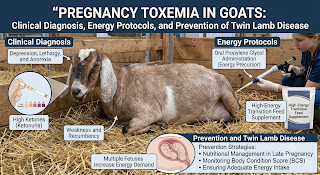
Pregnancy Toxemia, more commonly known as Ketosis, or Twin Lamb Disease (in small ruminants) is a metabolic disease affecting pregnant females during the last trimesters of pregnancy. Negative Energy Balance (NEB) is the underlying mechanism, which makes pregnancy toxemia prevalent mostly among high-yielding females carrying twins, triplets or quadruplets.
Whereas in dairy cattle ketosis is a disease associated with the peripartum period linked to the energy demands of lactation, caprine ketosis occurs before kidding. Unless the energy deficit is corrected, hepatic lipidosis (fatty liver) and ketoacidosis develop, precipitating rapid death of both the fetus and the mother.
1. Understanding the Pathophysiology of Negative Energy Balance (NEB)
During the last four to six weeks of gestation, the fetus grows at an extraordinary rate, accumulating more than 70% of its total weight during this period. This growth spurt places tremendous demands on glucose.
Physical Rumen Compression:
Multiple fetuses can cause a physical compression of the rumen, resulting in reduced Dry Matter Intake when the doe requires twice as much energy. The animal cannot compensate by increasing feed intake, so the body starts breaking down fat reserves. Fatty acids, however, overwhelm the liver, contributing to hepatic lipidosis and ketosis.
2. Dr’s Internal Dialogue: Differentiating between Caprine Pregnancy Toxemia and Ketosis in Cattle
I find it rather interesting to compare pregnancy toxemia in does to ketosis in cows. Unlike ketosis in cattle, which is a post-partum condition, pregnancy toxemia occurs pre-partum. When my client observes that his doe is not eating as much as the rest of the flock, he needs to know that waiting for the animal to lie down is not an option. I would advise him to talk immediately with the herd veterinarian about initiating a treatment course involving Glycerol plus a cocktail of B vitamins.
The addition of Glycerol will ensure that the liver has sufficient gluconeogenic precursors to produce glucose, thus satisfying the energy requirement of the doe and, by extension, the fetus. Early treatment prevents fatty liver and ketoacidosis.
3. The Prevention Protocol: Transition Diet For Pregnant Does
The best approach to preventing pregnancy toxemia is to implement a transition diet in the last month of pregnancy. The aim should be to observe steady weight gain in the doe and allow the animal to utilize the fat stores being mobilized.
A. Increasing Energy Density
The animal should be encouraged to eat more highly-concentrated feeds (such as breeder pellets or corn) to meet the increased energy requirements of pregnancy. Fiber should also be supplemented to support adequate rumen function.
B. Adding Glucogenic Precursors
This is the most effective approach to managing pregnancy toxemia and should be the default treatment in all confirmed cases. The addition of Glycerol (Glycerine) or Propylene glycol to the feed provides a ready source of glucose.
C. The Role of B Vitamins
The addition of B complex vitamins to the treatment regimen is also critical. They help the liver process the increased workload without producing excess ketones, thus preventing ketoacidosis.
4. Therapeutic Regimen + Dosage:
Copy-Paste Friendly Format
Below is a suggested treatment regimen for an average doe weighing between 100-150 lbs / 45-68 kg on a farm setting. The following are three distinct treatment options.
1. Oral Administration of Glycerol / Glycerine (or Propylene Glycol)
Indication
Glucogenic precursor for mild or moderate inappetence or as a supplement in cases of pregnancy toxemia.
Dose
60 to 90 mL – (2.0 to 3.0 oz.)
Route and Frequency
Two times a day (BID) either diluted in warm water for oral administration or using a drenching syringe.
Clinical Notes
Continue treatment until the animal’s appetite returns to normal and she begins eating concentrated feeds on a regular basis. Take extreme caution when administering oral liquids to avoid aspiration pneumonia.
2. Injection of B-Complex Vitamins with Thiamine & B12
Indication
Appetite stimulant, general metabolic tonic, and prevention of thiamine deficiency (polio) in pregnancy toxemia.
Dosage
Thiamine / B1: 10 TO 20 MG/KG (4.5 TO 9 MG/LB) – Intramascularly (IM) or Subcutaneously (SQ).
B12: 1 TO 2 {mL} TOTAL DOSE – Intravenous (IV)
Frequency
Every 12 to 24 hours
Clinical Notes
Supplement with Niacin (vitamin B3) at a dosage of 1 to 2 grams/day orally to inhibit excessive mobilization of lipids from adipose tissues in the liver.
3. Dextrose 50% (for recumbient animals or animals in severe distress)
Indication
Correction of hypoglycemia and treatment of pregnancy toxemia in severe cases or when the animal is unable to stand.
Dose
60 to 100 ml of 50 percent dextrose mixed in 500 ml of Normal Saline (0,9%) solution.
Route
Intravenous (IV) – slow infusion
Clinical Notes
Never administer directly Subcutaneously (SQ) – this will cause tissue necrosis and abscess formation.
5. Protecting Your High-Yielding Does
Does that regularly have twins or triplets of kids per pregnancy are the breadwinners of any commercial or home farm. As such, it is paramount to ensure that they are neither too fat nor too thin during the dry period. Maintaining them at a Body Condition Score (BCS) of 3.0 is ideal.