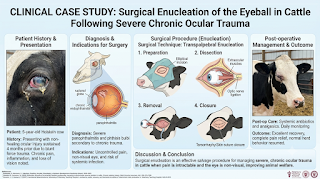
Severe eye injuries in large farm animals present a formidable challenge to veterinary practitioners. Left untreated or exposed to dust, flies, and secondary bacterial infections, an injured eye can quickly turn into a foul-smelling, sight-robbing abscess (endophthalmitis or panophthalmitis) that completely destroys vision.Surgical enucleation can be the best option to remove the source of constant pain, halt the spread of devastating tissue infection, and restore your pet’s health if the injured eye is blind, irreversibly necrotic, and causing an immeasurable amount of suffering.1. Case History & Clinical FindingsAn adult male cow presented with a serious history of ocular trauma occurring over a month before presentation. The owner reported that the animal had been consistently showing signs of severe distress:Persistent Pain & Distress: Constant head-rubbing, depression, and frequent rubbing of the affected eye against walls or posts.Purulent & Foul-Smelling Discharge: The eye socket was discharging a combination of blood, pus, and foul-smelling necrotic matter.Photophobia & Anorexia: Extreme sensitivity to light, keeping the eyelids pinched shut, and dullness and reduced feeding.Complete Loss of Vision: Clinical exam found total blindness in the affected eye, with severe pericorneal swelling, cloudiness, and tissue damage.2. Field Diagnostic Assessment & TriageOn physical examination, the eyeball was found to be irreversibly infected by deep, chronic infection throughout the ocular cavity. Due to total vision loss and persistent pain, conventional medical interventions such as topical or systemic antibiotic use would provide no benefit.A decision was made to remove the damaged globe surgically to prevent the infection from spreading up into the deepest bones of the orbital or central nervous system.3. Dr.’s Clinical Viewpoint on Large animal Ocular Surgery🩺 Clinical View on Large Animal Ocular Surgery:”In large animal practice, trying to salvage an eye that has been blind, necrotic, and infected for more than a month is counterproductive. The focus should switch from sight preservation to pain relief and infection control. A well-placed retrobulbar nerve block with 2% Lignocaine Hydrochloride will provide complete regional anesthesia, allowing us to safely separate the globe, securely tie the optic vessels to prevent bleeding, flush the orbit, and close the wound for quick healing.”4. Surgical Protocol & Local Anesthesia1. Restraint & Aseptic Preparation: The animal was safely restrained laterally. The area around the eye was clipped, shaved, and thoroughly disinfected with povidone-iodine and surgical spirit.2. Regional Anesthesia (Retrobulbar Nerve Block): A retrobulbar nerve block was carried out using 2% Lignocaine Hydrochloride to desensitize the eyeball, eyelids, extraocular muscles, and optic region.3. Surgical Removal (Enucleation):A circumferential skin incision was made along the eyelid margins, leaving as much healthy skin as possible.The conjunctiva and extraocular muscles were disfigured from the sclera.The optic nerve and associated blood vessels were identified, clamped, firmly ligated with heavy absorbable suture material to achieve complete hemostasis, and severed.The diseased eyeball was completely exteriorized and removed.4. Cavity Flushing & Wound Closure: The orbital socket was thoroughly flushed with warm antiseptic solution. The eyelid margins came together and were closed using routine interrupted sutures.5. Post-Operative Care & Follow-Up ProtocolSystemic Antibiotic Cover: Broad-spectrum parenteral antibiotics were administered for 5 to 7 days to resolve any remaining tissue infection.Pain & Anti-Inflammatory Management: Injectable NSAIDs (e.g., Meloxicam or Flunixin Meglumine) were given to manage post-operative swelling and surgical discomfort.Wound Dressing & Hygiene: Daily local antiseptic wound dressing was performed to keep the surgical line dry and free of flies.Suture Removal: Skin sutures remained intact and clean and were safely removed 10 to 14 days post-surgery following complete surgical union and clinical recovery.