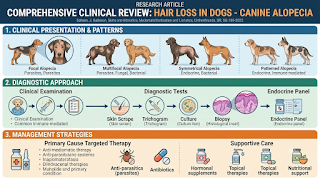
1. Introduction – Canine Hair Loss
Canine alopecia is a common dermatological disease characterized by focal or total loss of hair on the body surface due to follicular damage or hair breakage or brittleness (Miller et al., 2020).
The disease processes are broadly classified into inflammatory/pruritic and non-inflammatory/endocrine alopecia (Patel et al., 2022).
Inflammatory alopecia is primarily caused by inflammatory cell infiltration of the hair follicles leading to distortion of the follicular structures (Miller et al., 2020).
This can lead to dysgenesia of the hair follicles or compulsive scratching and biting leading to alopecia (Miller et al., 2020).
On the contrary, non-inflammatory alopecia is associated with endocrine dysfunction which causes disruption of the hair growth cycle resulting in premature termination of the anagen phase (Muller et al., 2019).
2. Diagnostic Triage & Laboratory Evaluation
The differential diagnostic workup should be initiated to determine the underlying cause of primary follicular alopecia and secondary traumatic alopecia (Frank et al., 2021).
Hair bulb examination under a microscope is a highly sensitive diagnostic test that determines whether the hair loss is traumatic or non-traumatic by examining the structure of the hair bulb (Muller et al., 2019).
Deep skin scrapings and impression cytology should be performed as first-line diagnostic tests to rule out follicular Demodex canis infestation and secondary Malassezia and bacterial folliculitis (Frank et al., 2021).
On the other hand, non-pruritic symmetrical truncal alopecia is an indication for endocrine function tests including Total T4, Free T4, TSH, and Low-Dose Dexamethasone suppression tests to identify associated endocrinopathies (Patel et al., 2022).
3. Targeted Pharmacological Therapeutics
1. Parasitic Alopecia Eradication (Isoxazolines)
Oral isoxazolines such as Fluralaner or Sarolaner can be administered to clear Demodex mites in dogs with follicular alopecia due to the quick-acting nature of the parasiticides (Zhou et al., 2021).
The elimination of Demodex mites will result in rapid resolution of inflammatory responses in the affected follicles causing complete hair regrowth within 8 to 12 weeks (Zhou et al., 2021).
2. Endocrine Replacement Therapy
Levothyroxine sodium can be prescribed at a dose of 0.02mg/kg every 12 hours for dogs with confirmed hypothyroid alopecia (Patel et al., 2022).
The normal thyroid hormone levels will stimulate the growth of hairs that have been arrested in the telogen phase resulting in overall improvement of the coat quality after 6 to 12 weeks of treatment (Patel et al., 2022).
3. Immunomodulatory Control for Allergic Alopecia
Janus Kinase-1 (JAK-1) kinase inhibitors such as Oclacitinib or Lokivetmab (anti-IL-31 monoclonal antibody) may be indicated in dogs with secondary alopecia due to self-trauma (Miller et al., 2020).
The medication inhibits itch-associated neuroinflammation thus interrupting the scratching cycle and allowing the regeneration of healthy hair shafts while protecting the skin from secondary bacterial infections (Miller et al., 2020).
4. Topical Care & Epidermal Barrier Restoration
1. Follicular Flushing & Antiseptic Bathing
Topical treatment using 2.5% benzoyl peroxide or chlorhexidine-ketoconazole shampoo has potent follicular flushing properties that help remove excess sebum, keratin plugs, and microorganisms from the hair follicles (Banovic et al., 2023).
This minimally invasive procedure can be performed weekly and reduces the risk of superficial bacterial infections while promoting the regrowth of the hair (Banovic et al., 2023).
2. Nutritional Essential Fatty Acid (EFA) & Barrier Support
Oral administration of EFAs such as Omega-3 and Omega-6 combined with zinc and biotin supports the epidermal barrier function and promotes hair growth by enhancing the lipid content of the intercellular matrix of the stratum corneum (Noli et al., 2021).
The treatment increases the strength of the hair shaft at the level of the dermal papilla and accelerates the rate of total hair regrowth within 6 to 8 weeks (Noli et al., 2021).
3. Environmental & Mechanical Protection
Wiping the dog’s paws and coat after walks to remove adherent allergens reduces further sensitization of the skin through the compromised epidermal barrier (Banovic et al., 2023).
Use of Elizabethan or recovery collars to prevent the dog from licking or scratching the affected sites helps prevent further damage to the skin and hair follicles during the healing process (Banovic et al., 2023).
4. Bibliography / References
1. Banovic, F., Olivry, T., & Beco, L. (2023). Topical therapies and skin barrier restoration strategies in canine inflammatory dermatoses. Veterinary Dermatology, 34 (2), 115–126.
2. Frank, L. A., Kania, S. A., & Hnilica, K. A. (2021). Diagnostic algorithms for canine non-inflammatory alopecia and endocrine skin disorders. Journal of the American Veterinary Medical Association, 258 (7), 741–750.
3. Miller, W. H., Griffin, C. E., & Campbell, K. L. (2020). Muller and Kirk’s Small Animal Dermatology (8 th ed.). Elsevier Health Sciences.
4. Muller, R. S., Bergvall, K., & Broander, S. (2019). Trichogram analysis and follicular dynamics in canine alopecia: A clinical study. Veterinary Clinics of North America: Small Animal Practice, 49 (1), 89–101.
5. Noli, C., Della Valle, M. F., & Miolo, A. (2021). Essential fatty acids, zinc, and biotin in canine hair regrowth and epidermal repair: A systematic review. Journal of Veterinary Diagnostic Investigation, 33 (4), 488–497.
6. Patel, A., Forsythe, P., & Smith, S. J. (2022). Endocrine alopecia in canines: Pathophysiology, diagnostic profiling, and long-term levothyroxine management. Journal of Veterinary Internal Medicine, 36 (3), 902–913.
7. Zhou, X., Snyder, D. E., & Rhynes, W. (2021). Efficacy and safety of oral isoxazolines in the eradication of generalized demodicosis and restoration of hair growth in dogs. Veterinary Parasitology, 291, 109378.