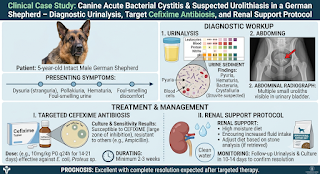
Let’s start understanding about Canine Lower Urinary Tract Disease (LUTD) incorporating acute bacterial cystitis and urolithiasis (urinary calculi), which is a frequent cause of visceral abdominal pain and behavioral distress in adult companion animals. German Shepherds and other large-breed dogs often present with subtle behavioral shifts like flank biting, targeting the abdominal area, and postural restlessness before overt hematuria is noticed by owners.
Identify urinalysis, accurate identification of pyuria/leukocyturia, and targeted antimicrobial therapy combined with mucosa-soothing antiinflammatories are critical to eliminate bacterial infection, prevent ascending pyelonephritis, and clear micro-calculi from the urinary tract.
1. Case History & Clinical Presentation
A 5-year-old intact male German Shepherd presented with a primary complaint of intermittent behavioral distress and abdominal discomfort during the summer season.
Upon clinical examination and history taking, the owner reported:
Visceral Pain Indicators: The dog exhibited marked restlessness frequently lying down, getting up, staring at its flank/abdominal area, and attempting to bite its lower abdominal wall.
Altered Voiding Pattern: Increased urinary frequency (pollakiuria) despite summer heat, accompanied by mild dysuria and discomfort during micturition.
No Prior Medication History: The animal had received no prior antibiotic or analgesic treatment for this episode.
Systemic State: Bright, alert, with normal body temperature and mucous membranes, but showing localized abdominal tenderness on deep palpation.
2. Diagnostic Urinalysis & Triage
A cystocentesis / free-catch midstream urine sample was collected for immediate laboratory analysis and microscopic examination.
Urinalysis Findings: Microscopic examination demonstrated significant leukocyturia/pyuria, with marked elevation of White Blood Cells (WBCs) and segmented neutrophils, confirming active bacterial infection of the urinary tract.
Differential Diagnosis: Acute Bacterial Cystitis, Urolithiasis (Cystic/Renal Calculi), Partial Urethral Obstruction, and Early Pyelonephritis.
3. Dr.’s Clinical Perspective
🩺 Clinical Rationale on Canine Urinary Tract Infection & Pain Management:
“Flank watching and localized biting at the abdomen in dogs are classic signs of visceral pain originating from the bladder or kidneys. When urinalysis reveals heavy neutrophilic infiltration, active bacterial cystitis is confirmed. A 3rd-generation cephalosporin like Cefixime (100mg) offers excellent tissue penetration and high urinary concentration against primary uropathogens like E. coli. Combining Cefixime with Meloxicam reduces painful mucosal inflammation and bladder spasms. To checkout suspected micro-calculi or gravel, herbal renal modifiers like Nephrotec aid in urinary tract flushing, while a short, conservative injection of Furosemide given after initial hydration promotes active diuresis and clears cellular debris from the lumen.”
4. Therapeutic Regimen & Dosage Protocol
The dog was placed on a structured 7 day outpatient therapeutic protocol:
1. Broad-Spectrum Antimicrobial Therapy
Drug: Cefixime (3rd Generation Cephalosporin)
Dosage: 100mg PO BID (Twice Daily)
Duration: 7 days
Indication: High urinary clearance and bactericidal activity against Gram-negative uropathogens.
1. Non-Steroidal Anti-Inflammatory & Analgesic Support
Drug: Meloxicam
Dosage: 0.2 mg/kg PO on Day 1, followed by 0.1 mg/kg PO SID
Indication: Relief of visceral pain, reduction of urinary bladder wall inflammation, and alleviation of dysuria.
1. Renal & Urinary Tract Support (Calculi Dissolution/Flushing)
Supplement: Tablet Nephrotec (Herbal Polyherbal Formulation)
Dosage: 1 to 2 tablets PO BID
Indication: Antiseptic, diuretic, and antilithic support to prevent crystal aggregation and soothe inflamed urethral mucosa.
1. Short-Course Diuretic Management
Drug: Furosemide (Rigot)
Timing: Initiated on Day 3 following adequate fluid loading and pain stabilization.
Dosage: Low conservative oral dose (1 to 2 mg/kg PO SID for 2 days)
Indication: Flushing cellular casts, bacteria, and micro-crystals out of the lower urinary tract.
1. Hydration Therapy & Environmental Care
Protocol: Owner was instructed to strictly enforce high fluid intake (fresh water bowls, broths, and wet food) throughout the treatment course to encourage continuous flushing of the bladder.
5. Clinical Outcome & Follow-Up
The patient demonstrated rapid clinical improvement within 48 to 72 hours of initiating therapy:
Day 3: Complete cessation of flank biting, abdominal targeting, and postural restlessness.
Day 7: Normal micturition pattern re-established with no signs of dysuria or stranguria.
Follow-up Urinalysis: Repeat urinalysis at the end of the 7-day treatment course confirmed complete resolution of WBCs and neutrophilia, indicating successful clearance of the urinary tract infection.
6. Urine Colour and related disease conditions :
Clear or pale urine indicates chronic kidney disease or diabetes, dark amber urine shows severe dehydration, red or pink urine signals a urinary tract infection or bladder stones, dark red or wine-colored urine means red blood cell breakdown from diseases like Babesiosis, dark brown or tea-colored urine points to severe muscle damage, yellow-green urine suggests liver problems or jaundice, and cloudy urine shows a bacterial infection with pus cells.